Showing posts with label Harry Potter. Show all posts

The End of an Era: Harry Potter #7

Dec 14, 2021

I read aloud the first Harry Potter book to Aaron and Maxwell when they were seven and five, respectively. 

It was always my plan to read one HP book every fall until we were finished with the series. And amazingly, we stuck with that plan. My kids never read ahead, even as their friends methodically spoiled every single plot point over the years. 

It has been something we've looked forward to with great anticipation at the beginning of every school year. Harry's adventures have been as distinct a part of the season for us as pumpkins and crunchy leaves.

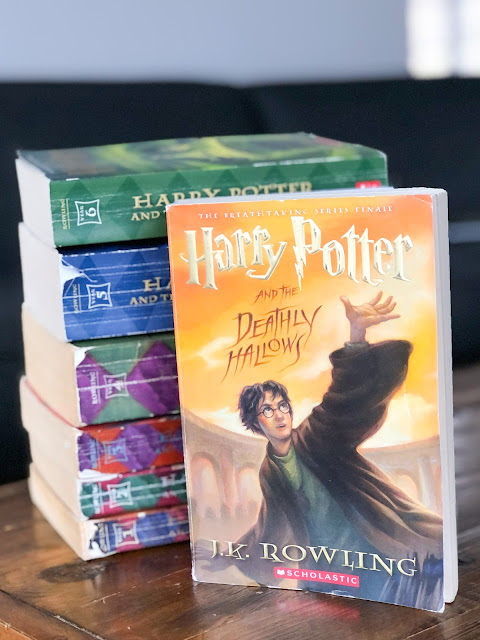
If you've done the math, you know where this is going, right? One book a year, starting in 2015, meant that we were up to #7, Harry Potter and the Deathly Hallows, this fall. Aaron and Maxwell are now 13 and 11, respectively. When we cracked the cover and read the opening line ("The two men appeared out of nowhere, a few yards apart in the narrow, moonlit lane"), it felt momentous--the beginning of the end.

To be honest, this seventh book was bittersweet, right from the start. I felt myself holding onto this sweet, fun tradition with my kids. We were excited to finally see how the series ended (especially me, since I had somehow managed to avoid most spoilers) but also so sad to know there wouldn't be any more books after this. 

Also, I know this won't be news to anyone, but this last book was intense. It was a continuous stream of battle followed by near-death (or death) followed by confrontation-with-Voldemort followed by battle, etc. What would have been the climax in any of the other books was just getting things going in this one. It felt a little relentless and exhausting, especially with so many favorite characters dying. My kids already knew about most of the deaths before they happened, but I didn't, and they took an emotional toll on me. 

And yet, despite it not being at all carefree or pleasant, this book was absolutely masterful. I was amazed with the way everything came together: pieces from past books suddenly returned with a purpose that was unseen before. Additionally, the complexity of the characters--their many layers and mistakes and triumphs--left us questioning our previous loyalties: Dumbledore so beloved but also selfish; Snape so despised but also loyal. 

As Harry himself grappled with combining what he thought he knew with unpleasant revelations, I found the following scene rather profound: Hermione said, "'But you know how much truth there was in everything Rita wrote about you! . . . How can you let these people tarnish your memories of Dumbledore?' [Harry] looked away, trying not to betray the resentment he felt. There it was again: Choose what to believe." I feel like this is the type of decision we all face at some point (sometimes over and over again): How are we going to move forward with the evidence we have about someone? Will we let the good in them overshadow the bad or vice versa? Will we give them the opportunity to become a better version of themselves? Or will we do all we can to keep them trapped in a self-made box of mistakes? As Kingsley later said, "Every human life is worth the same, and worth saving." 

We finished the seventh over Thanksgiving break. After reading a combined total of 4100 pages over the course of seven years on beautiful late-summer evenings on the front porch and chilly fall evenings around the fire, we finally read the words, "The scar had not pained Harry for nineteen years. All was well." It felt good. It felt satisfying. It felt right. But it also felt so, so sad. It is hard to see a good series come to an end, especially one that literally accompanied the coming of age of my kids. These books encompassed a significant part of their childhoods, and they will always remember them.

But as this annual tradition comes to a close, you might be wondering, "What about your other kids?" 

I'm kind of wondering the same thing.

You see, when I came up with this idea of reading one HP book every fall, it seemed so perfect. I wrote about all of my reasons for reading them aloud and spacing them out in this post from 2016. Everything in that post worked perfectly for Aaron and Max. From start to finish, the experience was dreamy and magical and just so fun. 

But you want to know who got the short end of the stick? Bradley.

This is how the Harry Potter series went for him:

2015 (Harry Potter and the Sorcerer's Stone): He was barely four years old and not interested in listening to a long book. 

2016 (Harry Potter and the Chamber of Secrets): He had a longer attention span and joined in the listening with his brothers.

2017 (Harry Potter and the Prisoner of Azkaban): He thoroughly enjoyed listening to the book.

2018 (Harry Potter and the Sorcerer's Stone): He was barely seven years old; I thought he was too young for the dark themes in #4; Mike started the series over with Bradley and Clark.

2019 (Harry Potter and the Chamber of Secrets): Mike read aloud to Bradley and Clark while I read #5 to Aaron and Max (side note: biggest slog of the series for us).

2020 (Harry Potter and the Prisoner of Azkaban/Harry Potter and the Goblet of Fire): Mike attempted to read #3 to Bradley and Clark; Clark got bored and complained about it every time they tried to read; Bradley got frustrated that they couldn't even make it through a book he'd already heard before; I compromised by letting him listen to the audio version of #4 on his own.

2021 (Harry Potter and the Order of the Phoenix/Harry Potter and the Half Blood Prince/Harry Potter and the Deathly Hallows): It was a bumper HP year for Bradley as I realized that things hadn't worked out for him. I let him listen to the audio versions of #5 and #6 so he would be caught up and be able to read #7 with Aaron, Max, and me.

Although the series ended on a high note for him, and it was so fun to have him back with us for the last book, I feel like his experience with the series was much different from the other two. And I feel really sad about that. For Aaron and Max, it was this seamless, predictable, comforting experience. For Bradley, it was a disjointed jumble. 

Looking back, I don't know what I should have done differently. All I know is that my "perfect plan" wasn't very perfect for him. Having a bigger family makes some traditions harder to navigate when you're trying to cater to different ages and needs. 

But looking forward, I'm making plans for what to do now. I can't imagine next fall without some Harry Potter in it. And I think Clark might finally be more on board with it and probably Ian, too. So I might just start over with the series, reading specifically to those two but knowing that Aaron, Max, and Bradley will most likely be pulled into the story again if they are home in the evenings. It might be even more of a family experience than it was the first time through, which might make it even better.

But I think I might let Jim Dale read #5 for me because I just don't know if I can do that one again. 

Harry Potter's Highest Priority

Nov 20, 2020


Harry Potter has become as much a part of our autumns as crunchy leaves, pumpkin carving, and Halloween costumes. When my boys are grown and think back on their childhoods, I know they will fondly remember the cozy evenings we spent immersed in the wizarding world of Hogwarts. And that makes me happy.

It's quite possible that Aaron and Max will remember this year's installment, Harry Potter and the Half-Blood Prince, better than any of the others. It was maybe the most enjoyable readaloud experience we've ever had, and that's saying something. They begged me to read it every night. They folded laundry if it meant I would read a little more. We spent Sunday afternoons reading just one more chapter. And they even woke me up on a Saturday morning to see if I would read before they had to start on chores. 

This was quite the contrast to last year. The fifth Harry Potter took us nearly five months to read, and it was something of a slog--a pleasant slog, but still a slog.

Not so with this sixth book. We blazed through it. The chapters melted away, one by one. There wasn't a moment of pause or drag. The story just flowed in that magical way that sometimes happens.

When we read the final line and closed the book, we felt immense satisfaction but also a keen sense of loss. We experienced withdrawals for several weeks after finishing. Sometimes Aaron would come into my room and open his mouth to start to ask for Harry Potter before remembering that there wasn't anymore left to read.

It was the first time I have been sorely tempted to just jump into the next book. I'm sure I wouldn't have met any resistance from Aaron or Max if I'd suggested it. But these books are as much about the ambiance and feeling of fall as they are about the stories themselves. We've created this experience, and it would be such a shame to break it for the final book. Plus, I know that the anticipation and excitement will only grow between now and next September.

I felt bad for the readaloud that followed this one. It probably didn't matter which book we chose, it wasn't going to be able to compete. The boys were completely unenthusiastic about it. It took us a good eight chapters before we were into it, and even then, it felt like we read aloud out of habit more than for the sheer pleasure of it. 

The one disadvantage of reading a book well after your peers is that many things have accidentally been spoiled for you (and in case you haven't read this book, this is your warning that I will be sharing spoilers here), including the biggest plot twist--that of Professor Dumbledore dying at the hands of Professor Snape. That moment has become a part of culture. Spoilers are unavoidable. 

But somehow, knowing that it was going to happen did not make it any less dramatic or heart-stopping when Snape raised his wand on top of the tower and uttered the fateful words. My eyes had skimmed ahead, and I had seen it before I actually read it aloud. It took my breath away, and I told the boys, "I can't read the next part. I just can't." I decided I was actually grateful many different people had spilled the ending many years ago. I think it might have been too traumatic otherwise.

Even though we knew the way the book would end, there were still many points of the plot that we knew nothing about, including who the Half-Blood Prince was. We discussed possibilities and mounting evidence, but we were still surprised when it was finally revealed.

Besides the pleasure I derived from reading this book, I also had a rather profound, maybe even spiritual, moment while reading.

During one of Harry's lessons with Professor Dumbledore, they visit a memory of Professor Slughorn's. It is incomplete and altered, but Dumbledore is convinced that the true memory will "undoubtedly be [the] most crucial piece of information of all" in understanding Voldemort. Dumbledore gives Harry the charge to find out the real memory from Slughorn. He emphasizes the absolute importance of this in their quest. Nothing else is of higher priority.

Harry doesn't doubt Dumbledore, but he doesn't have any great ideas for how to get Slughorn to trust him. And meanwhile, Draco Malfoy is definitely up to something. Harry can't figure out what it is, but it completely consumes him. He obsessively studies the Marauder's Map to track Malfoy's movements. He thinks about it all the time. He gathers evidence and comes up with all sorts of possibilities.

At their next lesson, Dumbledore asks, "Have you managed the task I set you at the end of our previous lesson?" Harry says that he asked Professor Slughorn about it, but Slughorn refused to give it to him. 

And then, Dumbledore says something that easily cuts down every single excuse: "And you feel that you have exerted your very best efforts in this matter, do you? That you have exercised all of your considerable ingenuity? That you have left no depth of cunning unplumbed in your quest to retrieve the memory?" 

Harry actually had been devoting that kind of effort, ingenuity, and cunning into a task, but it was not the one that Dumbledore had given him. Harry knew what the most important thing was. He even believed it was the most important thing. But something else won his attention because it was the thing that made his own prideful emotions flare up, and he couldn't let go of it.

With a start, I realized how many times I am just like Harry. I know what the important things are. I don't need to be convinced. But I don't give priority to them. I subconsciously know that those things will still be around whether I pay attention to them now or later. So I put them off in favor of more tantalizing endeavors. 

For Harry, it probably also had something to do with the fact that he felt unequal to the task. If he didn't try, then he hadn't failed yet, and that would give him more time. It is the same for me. I am crippled by the worry that I won't fulfill my highest objective, and so I would rather not think about it right now.

It has been almost a month since we finished this book, and I am still thinking about this part. I can't get Dumbledore's question out of my head, "May I hope, then, that you will give this matter higher priority from now on?" He could just as easily be asking that question of me. And I am determined to accept his challenge.

I know that this book is many people's favorite in the series, and it might be mine as well. Certainly a book that can be entertaining, compelling, and thought-provoking should be given the highest praise. I love that J.K. Rowling delivered some of her finest work towards the end of the series, and I couldn't have asked for a better reading experience than sharing it with my boys.

Harry Potter and the Prisoner of Azkaban by J.K. Rowling

Oct 31, 2017

We finished our annual Harry Potter reading two days before Halloween, and it was a treat from beginning to end (but especially the end). I'm so glad my boys will always link these books with the beginning of school and the anticipation of Halloween. It's so perfect.

This book marks the last HP I read as a teenager before I lost interest, which means that next year's reading of Harry Potter and the Goblet of Fire will be just as new for me as for my kids. Not that it helped a lot to have read this one before. Basically the only thing I retained was some vague memory of the dementors. I didn't even have any inklings that Sirius Black might not be the criminal and murderer he was made out to be, which means that the discovery of his innocence was just as unexpected for me as for my kids. And what could be better than reading a book a second time and having it be like the first time all over again? (And sorry, I hope I didn't just spoil anything for anyone, but I'm assuming that everyone has already read the books or seen the movies, and if you haven't, then I'm probably not the first one to accidentally reveal key plot lines to you.)

Harry's third year at Hogwarts gets an early kickoff when he lets his temper get the best of him and inflates Aunt Marge. He runs away and fortunately gets picked up by the Knight Bus--fortunate because the infamous Sirius Black, who blew up a street full of Muggles shortly after Harry's parents were killed, has inexplicably escaped from the inescapable Azkaban and is now on the run. There's reason to suspect he's on his way to Hogwarts to finish a job left unfinished twelve years before . . .

The best part of this book for me was learning about the friendship between Sirius Black, Remus Lupin, Peter Pettigrew, and James Potter. You know what it's like to be talking to friends you didn't know until you were all adults and learn about some of their mischievous, or even downright stupid, behavior as teenagers? It's shocking, right? Because here they are, right in front of you, posing as kind, responsible, intelligent adults. It's difficult to juxtapose the two versions of these people onto each other.

That's what it's like finding out that James Potter and his friends created the Marauder's Map, turned themselves into animals, and tried to tragically lure their peer, Severus Snape, to the Whomping Willow. I think by this point, the reader has put James Potter up on a kind of pedestal. We know he was instrumental in fighting against Voldemort and the Dark Arts and that he even nobly sacrificed himself to try to save his wife and Harry. All of these things make us think he was always full of good intentions and high ideals. But knocking him back down to a punk teenager making poor choices with his friends turns him into someone who is much more real for his flaws.

My boys' favorite part, besides the ending, was the Quidditch final. I think they'd read a whole book of nothing but Quidditch matches and commentary if there was one; they love it that much.

We read the last one hundred pages compulsively, as fast as we could, because we had to find out what was going to happen. If you had been a fly on the wall during those final chapters, you would have seen me, reading calmly in the chair, while Aaron, Maxwell, and Bradley paced feverishly around the room. Back and forth, back and forth, around the coffee table, over the couches, by the chair. The suspense was killing them, and they could not contain their energy.

And I don't blame them. If I hadn't been reading, I might have been wearing a path in the carpet right there with them. I loved that the ending this time was less about defeating the bad guy and more about saving Black. It was a nice change of pace.

At the end, Professor Dumbledore gives Harry this bit of wisdom: "Hasn't your experience with the Time-Turner taught you anything, Harry? The consequences of our actions are always so complicated, so diverse, that predicting the future is a very difficult business indeed." And yet, if anything, I think one of the takeaways from this book is that our actions do have consequences, even actions taken many years before, and I have a feeling many of the actions in this book will have consequences in future novels.

Two Halloween Readalouds: Harry Potter and the Chamber of Secrets and The Great Ghost Rescue

Oct 28, 2016

Our readalouds took a little seasonal turn during the last month. I had planned to squeeze in one more Halloween-themed novel (this list of Erica's is loaded with good ideas), but the library didn't cooperate with me. So I've moved onto planning next month's reads and would love some recommendations if you have a favorite book that would fit into the cozy, melancholy, grateful mood of November. But in the meantime, here's a look at what we did end up reading:

Harry Potter and the Chamber of Secrets by J.K. Rowling
This one should come as no surprise given my recent post about our family's reading plan for Harry Potter. We don't own the entire series (yet), but luckily we had this one. I say luckily because, for a book that's approaching twenty years old, you'd be surprised how difficult it is to land (and then keep) a library copy.

I was fourteen when this book came out in the U.S. My interest in Harry Potter hadn't fizzled yet, and I read it soon after it was released (as I recall, Harry Potter hadn't caught on in my little town at that point and so I don't think I even had to wait for anyone to read it before me). But now, seventeen years later, my memory served me very little during this second reading.

I didn't remember that Harry and Ron arrive at Hogwarts by illegally flying a car. I didn't remember anything about a little house elf named Dobby and his warnings. I didn't remember that Hermione is in an incapacitated state for part of the book. I didn't even remember Tom Riddle's true identity.

Most of the time, having such a poor memory is rather depressing, but when it comes to reading a book, it's actually rather fantastic. Here I was reading this book to my kids, and it was like I was experiencing the entire story for the first time. I bet some of you wish you could repeat your first experience with Harry Potter because really, there's just nothing like that first time.

So instead of just my kids hiding their eyes and yelling out and bouncing up and down with anticipation because they didn't know what was going to happen, I was right there with them. It was so much fun.

Aaron, Maxwell, and Bradley all listened to this one, and I will say that it got a little scary for them, especially Max. (At one point he admitted, "I am very concerned about this.") There were several times when he begged me to stop reading, but it was the kind of begging that happens when you're actually desperate to know what's going to happen but you don't know if you can handle it. It was the basilisk that really terrified him, and yet, when I got the audio for him after we'd finished the story, he listened to the last CD at least fifteen times and decided he wants to be a basilisk next year for Halloween, so I think it was the suspense of the unknown more than anything else that scared him (although we kept assuring him, "Max, this is just the second book, and there are five more after this, so we know Harry Potter doesn't die!").

One of the things that impressed me the most about this book was just how different it was from the first one. I think with a series like this where each book begins at the beginning of the school year and ends at the end, it would be easy for a lesser author to fall into a certain repetitiveness where some events stay the same between books. But as soon as Harry and Ron smash into the wall at Platform 9 3/4, you know not to expect anything. Of course, there are things that remain constant (Harry's friends and enemies, some professors, etc.), and this lends a continuity to the overall story, but there are many unexpected twists that keep the characters fresh and exciting. (At one point, my kids were just sure that Professor Lockhart was going to turn out to be the bad guy just like Professor Quirrel in the first book, but of course J.K. Rowling would never do such a thing, and they were delighted with where it actually ended up.)

It definitely doesn't have the kind of symbolism I love in The Chronicles of Narnia, but it still has some thought-provoking moments, like this wisdom from Professor Dumbledore at the end: "It is our choices, Harry, that show what we truly are, far more than our abilities."

Now we're all eagerly anticipating Harry Potter and the Prisoner of Azkaban, but in the meantime, we'll just relive and reread our favorite parts from the first two books.

The Great Ghost Rescue by Eva Ibbotson
I have wanted to read something by Eva Ibbotson for a long time. In fact, she was one of the authors who prompted me to make the goal, "Read a female author I've been meaning to read."

I always thought I'd start with one of her historical romances, like The Countess Below Stairs, but one day I was at our local thrift store and happened upon several children's fantasy books by her. Up until that moment, I didn't even realize she'd written for children. I read the backs of the books and they all sounded delightful, so I purchased a couple, this being one of them.

I thought it would be the perfect book to read to my kids in October, and it was, but it was not the perfect book for me.

Rick does not enjoy life at boarding school, but things perk up considerably when a family of ghosts think his dormitory looks like an inviting new home. You see, the ghosts all across England have a real problem: all their old, dilapidated houses are being torn down or "modernized." There are just getting to be fewer and fewer dwellings that are fit for ghosts. Rick decides to take up the cause of the ghosts and go see the prime minister of England, in the hopes that he will agree to set aside some land for a ghost sanctuary. But not everyone sees the situation as Rick does. In fact, one person in particular would like to see England completely purged of ghosts.

Okay, first of all, I have to tell you, my kids loved this book. The farther into it we got, the more I dreaded it and the more they wanted to read it. I would say things like, "I am so tired of this book" or "The sooner this book is over, the better," and they would respond with, "You can not stop reading it!!!"

So we made it all the way through, but it was a slog, no question. I'm still trying to figure out why I didn't like it. The writing itself was fine; the story was full of action and drama; and it definitely felt seasonal. But . . . I didn't like the ghosts. In fact, I found them rather repulsive and in possession of the most disgusting habits. To name a few: The mother of the family (the Hag) gives off the most offensive odors around the clock; and the daughter, Winifred, follows around a bowl of water to wash out her never-disappearing bloodstains; and also, Aunt Hortensia, who lost her head to one of Henry the Eighth's rages, now carries it around with her.

In small doses, all of these things might have been okay (I keep thinking back to Harry Potter and how I didn't mind Headless Nick or the other ghosts at all), but this book was saturated with ghosts. I mean, that's who the book is about! They're not sidekicks or secondary characters. Aside from Rick, they're it. If you can't champion the ghosts, you might as well not be reading the story.

So yes, I sound prejudiced and, sadly, not too different from the villain himself, but honestly, I can only handle reading about the smell of pig's intestines and eating maggot sandwiches for so long before I want to dry heave, and that's just not what I'm looking for in reading material, you know?

I'm not giving up on Eva Ibbotson, but this book was definitely not for me.

Did you read any seasonal novels with your kids this month? And do you have any recommendations for us for next month? Last year we read Farmer Boy, and it was such a perfect November book that I keep wanting to duplicate that experience. 

One Mom's Opinion on When to Read Harry Potter

Sep 20, 2016


A couple of weeks ago, the boys and I started Harry Potter and the Chamber of Secrets. Last September, we read Harry Potter and the Sorcerer's Stone. And next September, we'll read Harry Potter and the Prisoner of Azkaban. Are you picking up on the pattern?

I'm a planner by nature, and Harry Potter is one of those things I've thought long and hard about. I'm not exactly sure why deciding how and when to present this particular series has caused me so much grief. I never finished the series when I was a teenager (I made it to book three), and although I liked the books I read well enough, I definitely never caught HP fever.

So with that kind of apathetic attitude, you would have thought I would have had very little opinion about when and how (or even if!) my kids read the series. But I think seeing the way Harry Potter has become such an iconic figure in the literary world and also such a part of childhood made me realize that I couldn't ignore it. And if I couldn't ignore it, I might as well embrace it . . . and have some control over it.

I was talking to a few friends at the park a couple of weeks ago, and Harry Potter came up. I mentioned that we had just started the second book and that we were just going to read one each year until we finished the series. One of my friends incredulously asked, "So you're not going to read the last book until Aaron is thirteen years old?!" I have to admit that up to that point, I'd never really done the math. I mean, it should have been fairly obvious (there are seven books, and if you start when Aaron's seven years old and only read one each year . . . ), but it wasn't until someone else said it that I realized just how long this plan would take us.

And to be honest, it made me rethink it a little. Was I really going to make Aaron wait until he was in eighth grade to finish a series all of his friends read when they were in first?

But actually, getting older was one of my main reasons for doing the one-per-year plan, so after I got over the shock of thinking about Aaron being so old, thirteen actually sounded just about right. So right now, I'm sticking with my plan, and these are the reasons why:

1. My kids can grow up with Harry.
When the series begins, Harry is eleven; when the series ends, he is seventeen. It's a simple fact that eleven-year-old boys (and their friends) are not thinking about, talking about, or participating in the same things as seventeen-year-old boys (and their friends). And quite frankly, I'm not all that anxious for my seven-year-old to encounter some of those more mature themes. And then of course, the books deal with some really dark, scary, frightening things. No matter how mature a child might be, some wisdom can only be gained by growing up. Reading just one book a year lets that growing up happen in a natural way.
 
2. Fall is the best time to read Harry Potter.
You all know how much I love seasonal reading, and I'm convinced that Harry Potter was meant to be read in the fall. It just feels right to be reading about the beginning of a new school year, Quidditch matches, and Halloween when we're doing those same things in our own Muggle-lives. Not to mention that the whole book is filled with witches and wizards, which definitely gets us in the mood for October. I love traditions, and I like the thought that these books will always be linked to this season for my kids.

3. Reading these books as a family is beyond enjoyable.
Even if I'm not a die-hard Harry Potter fan, I have to admit that these are some of the most fun books we've ever read aloud. And even though I could just hand them to Aaron and let him read them on his own, I wouldn't want to. This is reading aloud at its finest . . . a completely magical experience. We all huddle together, sometimes physically, sometimes just figuratively, and hang onto every word--tensing up when something scary happens, cheering when something good happens, reliving favorite parts, and predicting what will happen next. Plus, I love doing all the voices (even though I'm not very good at them). 

4. There are so many other good books to read.
Since we've loved the first two books so much, I would just hate to feel burned out with Harry Potter. But I'm pretty sure if we read straight through the series, that's what would happen (at least for me). I have so many books on our to-readaloud list. My kids aren't going to outgrow Harry Potter for a long, long time, but they will outgrow some of the other books on my list. I'm not going to devote an entire year to reading Harry Potter and by so doing miss the chance to read some other fantastic books. I'm sure this is partly my own issue since I don't enjoy reading book after book in the same series without a break between, but I also like interspersing our fantasy with other genres.

5. We get to anticipate the next book.
Readers from my generation will remember what it was like before a new Harry Potter book came out: the weeks leading up to it were spent talking about it, rereading all the books that had already come out, and making plans for the book-release party. It was as exciting as Christmas. Personally, I didn't really participate in all the festivities because I wasn't all that interested, but I knew plenty of people who did. If I had to wait for one book each year and grow up a little and read other things in between, what would be so wrong about having my kids read them the same way? After we've read the book together, I'm fine with my kids reading it as many times as they want to by themselves, and I think rereading will only increase the anticipation of the next book. Isn't it so fun to have things to look forward to?

As great as my plan is, we're already running into little snags. For example, Bradley didn't listen to the first one last fall, but he's listening to the second one this year. He's still quite young (he'll turn five in a few days), and if he continues to listen with us, he's going to get to the more mature books before I'm ready. So I'm not sure what to do. Maybe next year, Mike can backtrack and read the first one to him, and then they can go on from there. And then what about Clark? The timing with the younger ones is just as tricky as with the older ones.

Also, I should probably mention that so far, my kids have been completely fine with this plan. They haven't begged to go onto the next book or continue with the series on their own. If they were chomping at the bit for the rest of the series, it would certainly make things more complicated (and I'm curious to know how those of you with voracious, fantasy-loving kids handle this). 

Of course, reading the books in this long, drawn-out way means that certain key plot twists will almost certainly be spoiled for the boys before we get there ourselves. But I'm pretty sure we crossed that bridge long ago, when Aaron was in first grade and all of his friends were reading the series on their own.  Six-year-olds don't really know how to give the"spoiler-free version."

I'm very curious to hear your opinions on this modern parenting dilemma. When did you let your kids read Harry Potter, and what were your thoughts and reasoning behind it?

Three Great Readalouds for Halloween: Harry Potter and the Sorcerer's Stone, The Wolves of Willoughby Chase, and The Little Leftover Witch

Oct 30, 2015

(This is also, "What I Read During My Break, Part 3," but I opted for the other title since they grouped themselves together so nicely. Plus, we just read The Little Leftover Witch this week (which means it wasn't actually one of the ones we read during my break).)

Harry Potter and the Sorcerer's Stone by J.K. Rowling book review
1. Harry Potter and the Sorcerer's Stone by J.K. Rowling

Have I ever told you about my history with Harry Potter? I was thirteen when the first book came out (in the U.S.). Growing up in a little, rural town in Colorado (and being homeschooled on top of that), I don't know when I would have heard about it enough to take notice of it if not for my grandma who enjoyed it immensely and told my family to read it. So I did, and I remember loving every minute of it.

By the time I read the first, I think the second one was already out, so I devoured it as well. And then I waited with great anticipation for the third. If I remember correctly, I think I even had to put my name on a waiting list at our little library (which I don't think I'd ever had to do before). It was about that time that my mom began to get a little worried that the series seemed to be getting darker with each book. She was concerned about where it was going to end up. And so, after I read the third, I took a break and never returned to the series. To this day, I've still only read the first three. Some of you are probably wondering how I could leave it so easily, but fantasy has never been my favorite genre and each book was more heavily saturated with fantasy elements, and so it wasn't that hard for me to just move onto other books.

Anyway, for years, I've meant to read the entire series, but it seemed like such a huge time commitment (those of you who have read the series at least a dozen times are probably balking at the notion that I would have to "force" myself to read them). I finally just decided to begin back at the beginning and read the first one aloud to Aaron and Maxwell. Almost all of Aaron's friends at school have read at least the first one, and I thought he might be missing out on some cultural references by not being familiar with Harry Potter jargon.

However bland my motives for reading it may have been, I can tell you this: it is one of the best readalouds we've read. The pull of the story that I remember so well from my own childhood was still there, and I don't think we ever closed it for the night actually wanting a break from it.

I know you don't need a summary (at age 11, orphan Harry Potter is summoned to Hogwarts School of Witchcraft and Wizardry. He finally learns the truth about what happened to his parents and bravely attempts to protect a life-giving stone that is being hidden at the school), so I'll just cut right to our impressions of it: we loved it, loved it, loved it.

Maxwell was so funny when I first pulled it out and said that it would be our next readaloud. "No way," he said. "I don't want to listen to it." And he actually left the room to go listen to what Mike was reading to Bradley. But after a little cajoling, I convinced him to listen to the first chapter, and then he was hooked. At the end of every chapter, he would beg, "Just one more! How about one more page? Or one more word?" He laughed every time he remembered how he almost missed out on one of his favorite books ever (I can't even count the number of times he's listened to the audio in the last three weeks).

But the last two chapters were the best. We read them on a blissfully uncluttered afternoon. You remember how the second-to-last chapter ends, right? "There was already someone there--but it wasn't Snape. It wasn't even Voldemort." My kids burst out with, "WHAT?! Who was it?!" I said, "Well, that's the end of the chapter" and began to close the book. There was a major protest, and I was so glad we were reading it at a time when we actually could go on, right then, and have our curiosity satisfied. But before we turned the page, we all took guesses about who was really in the room. And of course, neither of them even gave a thought to Quirrell, which made the turning of the page that much more exciting. Then of course there was the thrill of watching Harry defeat Quirrell and the final wrap-up of the first year at Hogwarts (my personal favorite part was when Neville was awarded ten points, and it was those ten points that tipped the scale in Gryffindor's favor--I'd totally forgotten about that). It really was such a perfect way to spend an afternoon.

2. The Wolves of Willoughby Chase by Joan Aiken

My mom has been telling me to read this book for years. It's one that I never heard growing up, but she read it to my younger siblings, and they all loved it. I've always had it in my head that it would make a good October read (and although it is winter for most of the book, the Gothic ambiance definitely makes it feel like it belongs to this time of year), and so it was on the short list for this month.

Bonnie Green is the only child of Sir Willoughby and Lady Green. They make their home at Willoughby Chase, an imposing and very comfortable estate (in the middle of nowhere and surrounded by starving wolves--not exactly its best selling points). Lady Green's health is poor, and so she and Sir Willoughby are leaving for a warmer climate for a few months, but Bonnie is staying behind. She doesn't mind; her cousin, Sylvia, is coming to stay with her, and her father has asked his distant cousin, Miss Slighcarp, to come be their governess while they are away.

But they are no more than a day's journey out of sight before things begin to go drastically wrong. Miss Slighcarp has no intention of being the girls' governess and instead has plans to take over the estate. She soon realizes Bonnie and Sylvia are in the way too much and sends them to live at Mrs. Brisket's boarding school (more like a prison than a school). Bonnie and Sylvia are miserable there, but Bonnie's spunky spirit is indomitable, and she soon thinks up a plan of escape.

The book reminded me a lot of Nancy and Plum, which we read last year, and which also features two little girls who are under the jurisdiction of an evil headmistress. I'd say this one is for slightly older children. The language is more complex (in the first chapter alone, we encountered the words "portmanteau," "goffering," "fowling piece," "hoydenish," "chatelaine," "oubliette," and "pelisse"), and the setting is a little more dismal and dire. I thought my kids might get tripped up by all the unfamiliar words (I certainly was tripping over them in my attempts to pronounce them), but the thing I'm quickly discovering as we read more and more challenging books is that they really don't focus on what they don't know (most of the words could be discerned from the context, and for the other ones, it was easy to stop and take a moment to define them) but on the story overall.

On the whole, we loved the book. There's just something about outwitting an evil governess that totally makes your day. This is exactly the kind of book I would have adored as a little girl. Bonnie and Sylvia are great counterparts to each other (brave and impetuous vs. cautious and attentive), and both of them are so kind to each other (although Bonnie does come off as a trifle spoiled).

We stayed up late one evening to finish it (a decision I definitely regretted the next morning in the face of irrational children), but it was such a dramatic conclusion, there was no way we could stop in the middle of it.

This is apparently the first book in a long series. My mom said they tried a couple of the following ones and weren't as enamored with them. Has anyone else gone on with the series? Thoughts? Opinions?

3. The Little Leftover Witch by Florence Laughlin

I found this book waiting for me on my hold shelf at the library one afternoon, and it baffled me because I hadn't the faintest recollection of requesting it. I think I must have heard about it on Instagram and asked for it right away and then had to wait for it for a couple of weeks, which gave me plenty of time to forget about it. Still, it's just a little eerie to go the library and find a totally unfamiliar book with your name on it. Especially when that book is about a little witch who practices some small magic (like perhaps reserving her book for an unsuspecting (but very regular) library visitor?).

Anyway, unfamiliar or not, it looked like a cute little book, so we read it. And I'm glad we did. It was short, very sweet, and even Bradley listened in on the entire thing.

It is Halloween night. Lucinda has taken off her ghost costume and crawled into bed. She's already asleep when she's woken by a strange noise. She finds a little bedraggled witch whose broom broke as she was flying home. All of the other witches have gone, and she must get home before midnight or she'll be stuck there until next Halloween.

Lucinda tries to help (even offering the vacuum cleaner), but the little witch just doesn't know enough magic yet to make it happen. And so Lucinda tells her she can stay with her family.

The little witch (whose name is Felina) is rude and uncooperative and only does the things she's supposed to when Lucinda's dad says, "that's an order." But Lucinda and her parents quickly grow to love her strange little ways, and gradually, she warms up to the family as well. As her heart softens, she knows she will do anything to stay with them forever.

This was first published in 1960 (and then came back into print in 2013). There are little references here and there which date it (like when Lucinda's mother receives a record player for Christmas), but overall, it's just a great little story that seems to have lost none of its charm in the last fifty-five years.

I will say that you do have to read between the lines a bit at the end of the book. If taken the way it was intended, then Felina is a lonely little girl who happily finds a family who adores her and wants to keep her forever. If taken the wrong way, it looks a little like she gives up her identity to conform to the Doon's expectations of what "normal" is. (Plus, there is a witch searching the skies for her towards the end of the book, but no one points this out to Felina, and a part of me wondered if there was a family on the other other side who wanted her back.) By all indications, Felina seems to have never experienced love or acceptance before living with the Doons, but I think you could interpret this story either way. I'm choosing to go with the way the author imagined it, but I can see some other readers taking fault with that aspect of the story.

Overall though, it was just a really cute, imaginative little story. It would be the perfect thing for curling up with after you get home from trick-or-treating.

What have you been reading to your kids this month?
Proudly designed by Mlekoshi playground